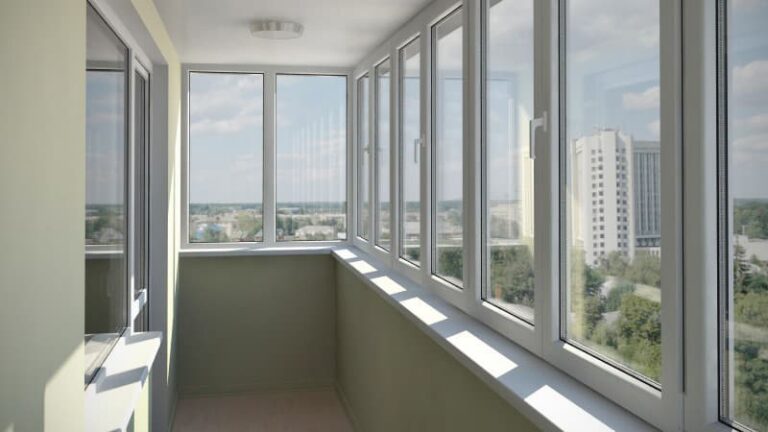
A balcony is a place where you want to drink your morning coffee and sit with a book in the evening. But in summer, in Tallinn and other Estonian cities, many balconies turn into something halfway between a sauna and a greenhouse. It’s impossible to go out there in the middle of the day. Worse still, an overheated balcony draws the heat into the flat.
Let’s find out why glazed balconies in particular get so hot and what can be done about it.
Glass — it is the perfect heat trap
Ordinary glass is transparent not only to visible light, but also to infrared (thermal) radiation. Sunlight passes freely through it into the room. The balcony’s walls, floor and ceiling absorb the heat and begin to radiate it back — but in the long-wave range, which is barely transmitted back through the glass.
This is the greenhouse effect in miniature. Heat gets in easily — but hardly ever gets out. On a sunny July day, the temperature on a glazed balcony in Tallinn can be considerably higher than outside.
3 reasons why the balcony gets hotter than the rooms
The area of glazing is disproportionately large. In a normal room, windows occupy part of a wall. On a balcony, three out of four sides are glazed. The flow of heat entering through the glass is several times greater than that entering a living room through a single window.
Ventilation is minimal. An enclosed balcony is a self-contained space. Hot air cannot escape: it builds up and continues to heat up.
The balcony protrudes beyond the building’s façade. As it is glazed on three sides, the sun shines in both directly and from the side. South- and west-facing balconies are particularly affected — the sun shines on them during the hottest part of the day.
The balcony as a heat pump for the flat
It’s not just a matter of discomfort. Heat actively flows into the flat through the balcony doors and the adjoining walls. If you have an air-conditioner, it has to contend with both the outside temperature and the overheated balcony at the same time. If you don’t have an air-conditioner, the room adjoining the balcony becomes the hottest in the flat.
That is precisely why fitting sun-protection film to balcony glazing has a dual effect: it makes the balcony itself more comfortable and keeps the adjoining rooms noticeably cooler.
Why curtains and blinds don’t solve the problem
The logical first step is to hang thick curtains or roller blinds on the balcony. But this is a trap: the fabric absorbs the sun’s heat and starts to release it indoors, acting like a radiator. The heat is already inside; it needs to be vented somewhere, but there’s nowhere for it to go.
The logic is the same as for bedroom windows: block the heat before it gets inside. This is explained in detail in our article on protecting your bedroom from the heat and white nights.
How does sun protection film work on balcony windows?
A high-quality sun-protection film reflects infrared radiation directly off the glass — before it enters the room. Natural daylight passes through the film-coated glass, but without the heat. The room remains bright, but no longer feels like an oven.
In practice, this means the temperature on the balcony drops by 5–10 degrees on a sunny day. And as the heat transfer into the flat via the balcony also decreases, the air conditioning in the adjoining rooms begins to operate in a noticeably more economical mode. Essentially, this creates a combination of air conditioning and sun-protective film.
Which film should I choose for my balcony?
For balcony glazing, external installation is generally the best option — it provides maximum thermal efficiency and does not cause thermal shock to the double-glazed unit. To find out more about the difference between internal and external application, and why this is particularly important for modern windows, see our article „Internal or external film“.
In terms of coating types, mirrored or sputtered films with a high reflectance percentage are ideal for south- and west-facing balconies. For glazing exposed to less intense sunlight, neutral tinted coatings are suitable, as they have a gentler effect on the light flux.
FAQ
-
Won’t it get dark on the balcony?
No. The film reduces brightness and heat gain, but it doesn’t turn the balcony into a dark room. Natural light is still let in — just without the blinding glare and heat.
-
Will the film damage the balcony glazing?
A film that has been correctly selected and professionally fitted will not damage the glass. The key point is to choose the right type of installation for the specific double-glazed unit in order to avoid thermal stress.
-
Will the installation pay for itself?
If you have an air conditioner — yes, by reducing the load on it. If you don’t have an air conditioner — you simply get a functional balcony instead of a non-functional one. To find out how the savings are calculated, read about the payback period of two seasons.
Conclusions
A glazed balcony overheats the most precisely because glass is an ideal conductor of solar heat, and the enclosed space prevents it from escaping. Curtains and blinds do not solve the problem; they merely shift the heat into the room.
Единственный способ разорвать этот цикл — остановить тепло на стекле. Этим летом балкон может снова стать местом, где приятно находиться.
Would you like to have a film applied to the glass? 👉 Submit a request
Here at aknakile24, we’ll select and install the right covering to suit your glazing and the orientation of your balcony.